
Ethylene diamine
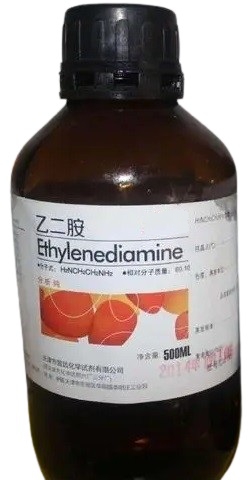
- Molecular Formula: C2H8N2
- CAS No.: 107-15-3
- EINECS No.: 203-468-6
Synonym: 1, 2-diaminoethane
Ethylene diamine technical data:
| Ethylenediamine content/% | ≥99.0 |
| Crystallization point/℃ | ≥10 |
| Chromaticity/HaZen Unit | ≤10 |
| Evaporation residue content/% | ≤0.03 |
| Total heavy metals (Calculated by Pb)/% | ≤0.0002 |
| Density | 0.872g/cm3 |
| Melting point | 11 ℃ |
| Boiling point at 760 mmHg | 119.671 ℃ |
| Flash point | 33.889 ℃ |
| Refractive index | 1.4555-1.4575 |
| Vapor pressure at 25 ℃ | 15.778mmHg |
| Vapor density | 2.07 (vs air) |
| Solubility | Miscible |
Chemical Properties;
1. Chemical properties: When placed in air, it absorbs moisture or carbon dioxide to form carbamate (white solid). The chemical properties are active, it releases heat when dissolved in water, and the aqueous solution is strongly alkaline. Generate crystalline and water-soluble salts with inorganic acids. When its nitrate is heated, 2 molecules of water are removed, generating explosive ethylenediamine.
2. Reacts with organic acids, esters, anhydrides, or acid halides to produce mono – or di substituted amides. When a substituted amide is heated, it condenses to form 2-alkylimidazoline. Condensation with dicarboxylic acid to form polyamide resin. Reacting with halogenated hydrocarbons to obtain monoalkyl or dialkylethylenediamine. Reacts with acrylonitrile to produce nitrile ethyl compounds. Reacts with epoxy compounds to generate addition compounds. The reaction with aldehydes mainly generates Schiff bases. It reacts with formaldehyde to form a complex mixture. Reacting with chloroacetic acid yields ethylenediaminetetraacetic acid salt (EDTA), which is a useful chelating agent. Reacts with urea, diethyl carbonate, phosgene, or carbon dioxide to primarily produce 2-imidazolidinone. Heating to 350 ℃ in the presence of nickel, cobalt, or copper catalysts produces piperidine. Reacting with carbon disulfide to produce dithioethylenediaminocarboxylic acid, heating to remove hydrogen sulfide to obtain polythiourea resin.
3. Stability: Stable
4. Prohibited compounds: acids, acyl chlorides, acid anhydrides, strong oxidants
5. Aggregation hazard: non aggregation
6. Decomposition product: ammonia
Application:
Ethylenediamine is used as a solvent in electrochemistry and analytical chemistry. Due to its strong affinity for carbon dioxide, hydrogen sulfide, carbon disulfide, thiols, sulfur, aldehydes, phenols, etc., it can be used as a gasoline additive, lubricant, fish oil, mineral oil, and alcohol refining agent. In addition, it is also used as a solvent for fibers and proteins, as a curing agent for epoxy resins, and as a manufacturing raw material for pharmaceuticals, pesticides, dyes, textile finishing agents, metal chelating agents, preservatives, ion exchange resins, latex stabilizers, rubber vulcanization accelerators, antifreeze, etc.
Storage:
Store in a cool and ventilated warehouse. Stay away from sources of fire and heat. The storage temperature should not exceed 30 ℃. The packaging requires sealing and must not come into contact with air. It should be stored separately from oxidants, acids, etc., and avoid mixing storage. Adopt explosion-proof lighting and ventilation facilities. Prohibit the use of mechanical equipment and tools that are prone to generating sparks. The storage area should be equipped with emergency response equipment for leaks and suitable containment materials.