
Sodium thiosulfate
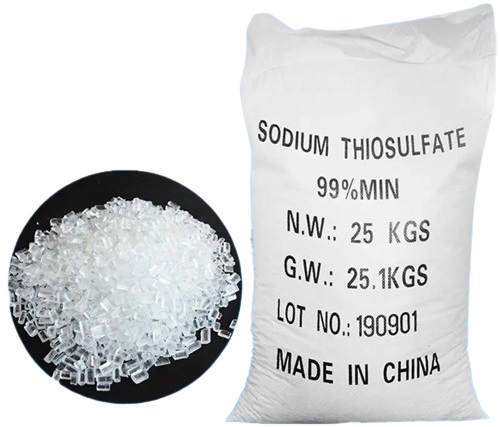
Synonyms: Sodium hyposulfite, Hypo, Sodium thiosulfate pentahydrate, Sodium thiosulfate anhydrous
- Molecular Formula: Na2S2O3·5H2O
- Molecular Formula: Na2S2O3
- CAS No.: 10102-17-7
- CAS No.: 7772-98-7
- EINECS No.: 231-867-5
- EINECS No.: 231-791-2
Sodium thiosulfate technical parameters:
| Items | Crude | First class | Superior grade |
| Appearance | Light yellow crystal | Colorless transparent crystals | Colorless transparent crystals |
Content | ≥95.0% | ≥98.0% | ≥99.0% |
Water insolubles |
| ≤0.03% | ≤0.01% |
pH (200g/I solution) | 6.5-9.5 | ||
Packaging method | 50kg/bag | ||
Application:
1. Detoxification
Sodium thiosulfate is an antidote for cyanide. With the participation of thiocyanate enzyme, it can bind with cyanide ions that are free or bound to methemoglobin in the body, forming non-toxic thiocyanate salts that are excreted from urine to relieve cyanide poisoning. In addition, it can combine with various metal ions to form non-toxic sulfides that are excreted in urine, and also has a desensitizing effect. Clinically used for the treatment of cyanide and nitrile poisoning, arsenic, bismuth, iodine, mercury, lead and other poisoning, as well as for the treatment of skin itching, chronic dermatitis, chronic urticaria, drug rash, scabies, tinea, etc. This medicine is not suitable for oral administration. After intravenous injection, it quickly distributes to the extracellular fluid of various tissues, with a half-life of 0.65 hours. Most of it is excreted in its original form through urine. Cyanide poisoning is commonly treated by slow intravenous injection of 12.5-25g. Metal poisoning or desensitization treatment: 0.5-1g/time, intravenous injection.
2. Other
Mainly used as a fixative in the photography industry. Secondly, when tanning leather, it is used as a reducing agent for dichromate, a neutralizing agent for nitrogen-containing exhaust gas, a mordant, a bleaching agent for wheat straw and wool, and a dechlorination agent for pulp bleaching. It is also used in the manufacturing of tetraethyl lead, dye intermediates, and silver extraction from ores.